



In a world obsessed with laser-focused targeting, imagine a strategy that swaps the sniper’s rifle for a net—casting wide to catch everyone who matters. Enter the Anti-ABM approach: instead of chasing a handful of high-value accounts, it floods hyper-specific micro-niches with content so relevant that it feels tailor-made.
Picture a bakery crafting 50 unique cupcake recipes for 50 tiny dietary communities—gluten-free marathon runners, vegan gamers, keto grandparents—each feeling seen, heard, and hungry.
This isn’t about ignoring precision; it’s about redefining it. By saturating overlooked corners of the market with value, brands build trust, authority, and a chorus of loyal advocates that traditional ABM might miss.
In an era where audiences crave personalization but hate being ‘targeted,’ the anti-ABM strategy for B2B lead generation isn’t just counterintuitive—it’s a quiet revolution. Ready to dive in? Let’s explore how less focus might just mean more impact.
Account-based marketing (ABM) revolutionized B2B sales by focusing on personalized outreach to high-value accounts. But today, its effectiveness is waning.
Why? Markets are oversaturated. When every vendor targets the same Fortune 500 companies or decision-makers, campaigns blend into noise.
Why It’s Failing
%20in%20B2B.jpg)
ABM assumes that precision guarantees results. But in crowded markets, hyper-targeting becomes a race to the bottom. Decision-makers tune out repetitive messaging, and differentiation vanishes.
ABM isn’t dead—it’s exhausted. To stand out, brands must pivot from whom they target to how they engage.
The “Anti-ABM” strategy isn’t about abandoning account-based principles. Instead, it flips the script: Flood overlooked micro-niches with hyper-relevant content to dominate smaller, less competitive audiences.
How It Differs from ABM
The Philosophy
Anti-ABM bets on volume and relevance. By catering to underserved niches, brands become the “only solution” for specific problems. Data reveals that micro-niche content generates 50% higher engagement than generic ABM campaigns.
Anti-ABM isn’t anti-targeting—it’s anti-monotony. It replaces narrow precision with wide relevance.
Micro-niches are hyper-specific audience segments often ignored by broad ABM campaigns. Think: “sustainability managers at mid-sized European manufacturing firms” or “IT directors at K-12 school districts.” These groups are small but hungry for solutions.
Why They Matter
Real-World Example
A cybersecurity company targeting “midsize e-commerce startups in Southeast Asia” grew its pipeline by 200% in six months. Competitors focused on broader “e-commerce” missed this segment entirely.
How to Find Micro-Niches
The Anti-ABM strategy relies on content tsunamis—massive waves of hyper-relevant content aimed at micro-niches. But how do you flood a market without overwhelming buyers? The answer lies in precision, not volume.
How to Execute a Content Tsunami
Why It Works Without Annoying Buyers
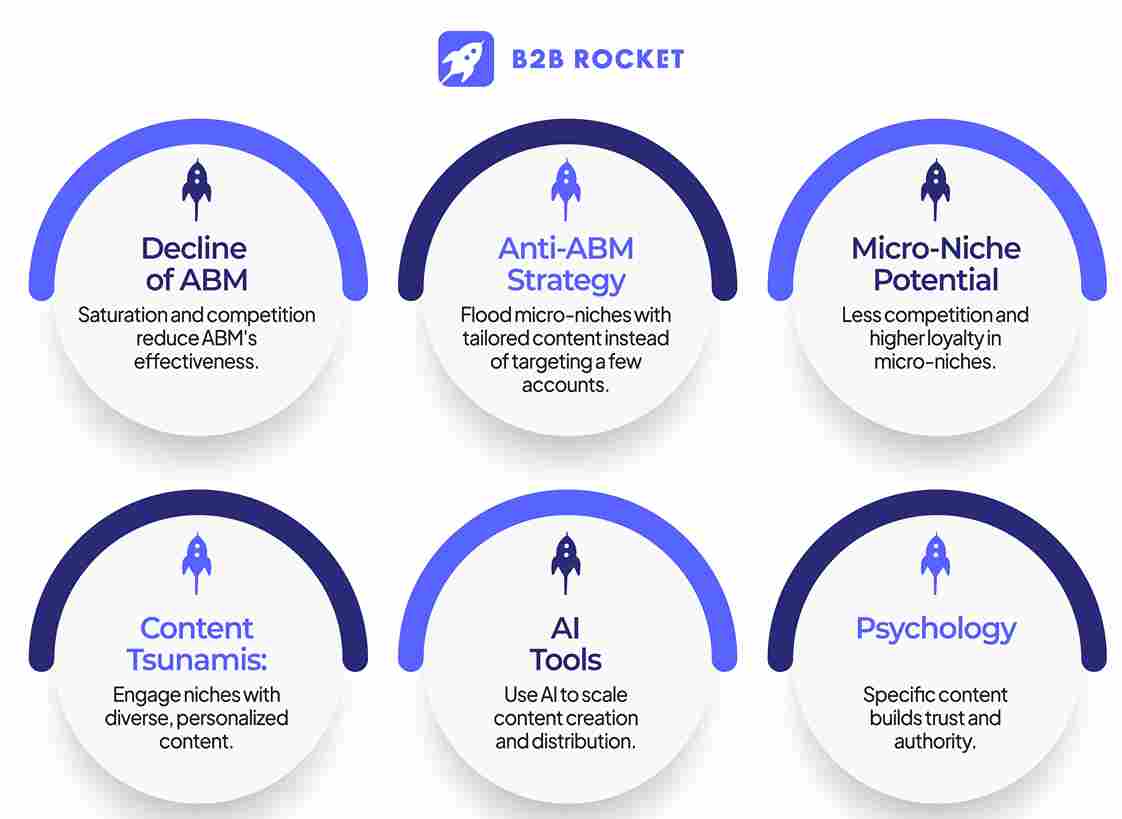
A content tsunami isn’t about shouting louder—it’s about speaking directly. Saturate micro-niches with value, not noise.
Pulling off an anti-ABM strategy requires tools that balance scale and specificity. Here’s the tech stack making it possible:
Tired of shouting in crowded markets? Our B2B Rocket’s AI agents help you dominate micro-niches effortlessly. From hyper-targeted content creation to pinpointing underserved audiences, our tools turn overlooked corners of your market into loyal customer bases—no manual grind required.
Anti-ABM thrives on a counterintuitive truth: the more specific the content, the harder it is to ignore. Here’s the psychology behind it:
Data Insight: Brands using Anti-ABM report 45% higher conversion rates in niche markets compared to broad ABM campaigns. Why? Buyers feel understood, not sold to.
The Anti-ABM strategy shifts focus from hyper-targeting a few accounts to dominating overlooked micro-niches. Here’s your actionable playbook to execute it:
Goal: Pinpoint underserved audiences with specific, urgent needs.
How to Do It:
Example: A payroll software company discovered a micro-niche: “HR managers at remote-first law firms.” This group struggled with multi-state tax compliance—a pain point ignored by broader HR tools.
Data Insight: Brands that define micro-niches with search volumes under 1,000/month see 3x higher engagement than those targeting high-competition keywords.
.jpg)
Goal: Flood the niche with content that feels custom-built for them.
How to Do It:
Example: A cybersecurity brand created a video series titled “Zero-Trust for Rural Hospitals,” addressing unique infrastructure challenges ignored by competitors.
Data Insight: Micro-niche content generates 50% more shares than generic B2B content as audiences feel “seen.”
Goal: Saturate the niche across every platform they use.
How to Do It:
Example: A CRM tool targeting “nonprofit volunteer coordinators” flooded Facebook groups and niche newsletters with guides like “Retaining Seasonal Volunteers in 2024.”
Data Insight: Daily micro-niche posts see 2x higher engagement of weekly blasts.
Goal: Scale personalization without losing specificity.
Tools to Use:
Data Insight: Teams using niche-focused tools reduce lead acquisition costs by 35%.
Goal: Refine your flood and replicate success.
How to Do It:
Example: A SaaS company found its “payroll for pop-up restaurants” content drove 80% of leads. They replicated the model for “payroll for food trucks,” boosting sales by 120%.
Data Insight: Brands that iterate weekly see 40% faster growth in niche markets.
Picture a crowded marketplace where everyone shouts the same offers. That’s ABM today. Enter the “Anti-ABM” playbook: instead of fighting for attention in packed arenas, dive into hidden streams—micro-niches.
These tiny, overlooked groups, like “HR managers at remote law firms” or “sustainability leads in mid-sized factories,” crave solutions tailored just for them. By flooding these spaces with hyper-relevant content—blogs, videos, case studies—you become their go-to ally, not another noisy vendor.
Ready to own your micro-pond? B2B Rocket equips teams to dominate niche markets with precision, flooding overlooked audiences with hyper-relevant content at scale. No more shouting in crowded arenas—just strategic waves of value that turn micro-niches into loyal customer bases.
Book more deals and drive revenue on autopilot with Al agents, real data, and multichannel outreach.

Work 24/7 to find, engage & qualify leads.

48+ contacts to reach the right people.
.svg)
Email, Linkedin & more. All in one place.
Automate, optimize & close more deals.










.svg)
.svg)
.svg)
.svg)

